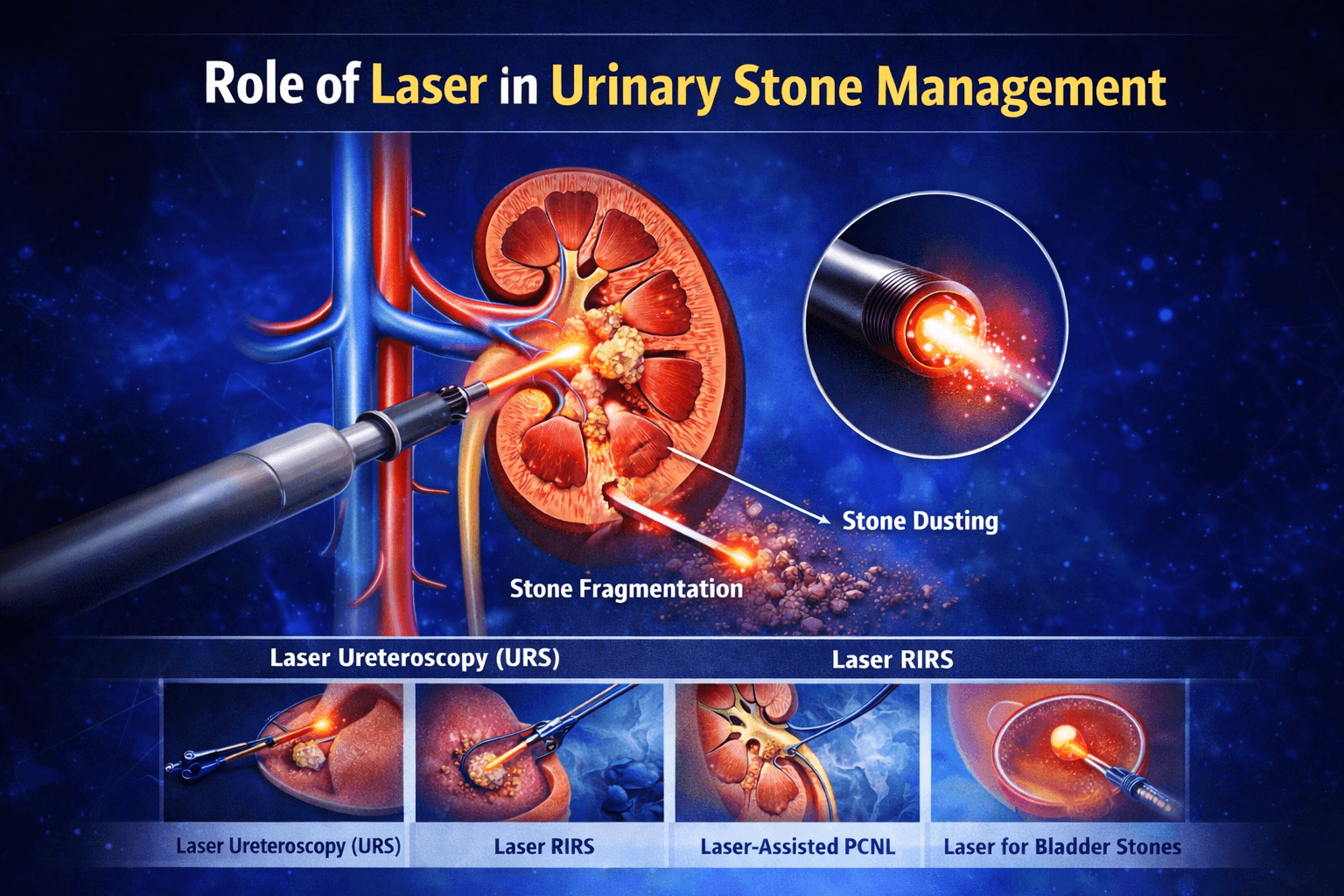
The Role of Laser in Urinary Stone Management:
Urinary stone disease affects approximately 10-15% of the global population, causing severe pain and potentially serious complications. While traditional methods of stone removal have been available for decades, laser technology has revolutionized urinary stone management, offering patients safer, more effective, and minimally invasive treatment options. This comprehensive guide explores how laser technology is transforming the landscape of kidney stone treatment and what patients can expect from these advanced procedures.
Urinary stones, whether in the kidney, ureter, or bladder, can cause debilitating pain and serious complications. For centuries, managing these stones involved invasive surgeries or painful passing. However, advancements in medical technology, particularly the integration of laser technology, have transformed how urologists treat urinary stone disease.
Understanding Urinary Stone Disease
Urinary stones, also known as urolithiasis or nephrolithiasis, are hard mineral deposits that form in the kidneys, ureters, bladder, or urethra. These stones develop when minerals and salts in urine crystallize and bind together, creating solid masses that can range from tiny grains to golf ball-sized formations. The most common types include calcium oxalate stones, uric acid stones, struvite stones, and cystine stones.
The prevalence of urinary stones has been steadily increasing worldwide, partly due to dietary changes, lifestyle factors, and rising obesity rates. When stones become large enough or move through the urinary tract, they can cause excruciating pain, bleeding, urinary obstruction, and infection. Effective treatment is essential not only for symptom relief but also for preventing long-term kidney damage and recurrent stone formation.
Evolution of Stone Treatment: From Open Surgery to Laser Technology
Historically, treating urinary stones required invasive open surgery, which involved large incisions, extended hospital stays, and lengthy recovery periods. The 1980s brought extracorporeal shock wave lithotripsy (ESWL), a non-invasive technique using shock waves to fragment stones. While revolutionary at the time, ESWL had limitations including lower success rates for larger or harder stones and potential kidney tissue damage.
The introduction of laser technology in the 1990s marked a paradigm shift in urological practice. The Holmium:YAG (yttrium-aluminum-garnet) laser, first approved for urological use in the mid-1990s, quickly became the gold standard for endoscopic stone treatment. This technology allowed urologists to directly visualize and pulverize stones with unprecedented precision, dramatically improving treatment outcomes while minimizing complications.
Today, laser lithotripsy represents the most advanced and versatile approach to urinary stone management, offering solutions for stones of virtually any size, composition, and location within the urinary tract.
How Laser Lithotripsy Works
Laser lithotripsy uses concentrated light energy to fragment urinary stones into small pieces that can be removed or passed naturally. The procedure typically employs the Holmium:YAG laser, which produces short pulses of infrared light at a wavelength that’s highly absorbed by water and stone material.
During the procedure, a urologist inserts a thin, flexible or rigid telescope called a ureteroscope through the urethra and bladder into the ureter or kidney. The ureteroscope contains a small camera that provides real-time visualization of the stone. A laser fiber, approximately the thickness of a human hair, is then passed through the working channel of the ureteroscope and positioned against the stone.
When activated, the laser delivers rapid pulses of energy that create a photomechanical effect, fragmenting the stone into smaller pieces. The urologist can adjust laser settings to either break stones into tiny dust-like particles that wash out naturally (dusting technique) or fragment them into larger retrievable pieces (fragmentation technique). The precision of laser technology allows treatment of stones in delicate locations without damaging surrounding tissue.
Types of Laser-Assisted Procedures for Urinary Stones
Ureteroscopic Laser Lithotripsy (URS): This minimally invasive procedure treats stones located in the ureter or kidney. Using a flexible or rigid ureteroscope, the surgeon navigates to the stone and uses laser energy to fragment it. URS with laser lithotripsy has become the preferred treatment for ureteral stones and many kidney stones, particularly those smaller than 2 centimeters. The procedure typically requires no incisions, and many patients return home the same day.
Percutaneous Nephrolithotomy (PCNL) with Laser: For larger kidney stones (typically greater than 2 centimeters) or complex stone formations, PCNL combines traditional percutaneous access with laser technology. A small incision is made in the back, and a nephroscope is inserted directly into the kidney. The laser then fragments the stone, and pieces are removed through the access tract. Modern mini-PCNL and ultra-mini-PCNL techniques use even smaller instruments, reducing tissue trauma and recovery time.
Retrograde Intrarenal Surgery (RIRS): This advanced technique uses a flexible ureteroscope to access stones deep within the kidney’s collecting system. RIRS with laser lithotripsy is particularly valuable for treating stones in difficult-to-reach locations, patients with anatomical abnormalities, or those who have failed other treatment modalities. The procedure leaves no visible scars and offers excellent stone-free rates.
Advantages of Laser Technology in Stone Management
Superior Efficacy: Laser lithotripsy achieves stone-free rates exceeding 90% for most stone types and locations. Unlike ESWL, which can struggle with harder stones like cystine or calcium oxalate monohydrate, lasers effectively fragment all stone compositions. The ability to directly visualize and treat stones under real-time guidance ensures thorough treatment and reduces the likelihood of residual fragments.
Minimally Invasive Approach: Laser procedures typically require no external incisions. The ureteroscope enters through the body’s natural openings, eliminating visible scarring. This minimally invasive approach translates to less postoperative pain, shorter hospital stays, faster recovery, and quicker return to normal activities. Many patients undergo outpatient procedures and resume regular routines within days.
Precision and Safety: The pinpoint accuracy of laser technology allows surgeons to target stones while preserving surrounding healthy tissue. Modern laser systems offer adjustable power settings and pulse durations, enabling customized treatment based on stone characteristics. This precision significantly reduces the risk of complications such as ureteral perforation, bleeding, or stricture formation.
Versatility: Laser lithotripsy effectively treats stones of virtually any size, from tiny fragments to large staghorn calculi. The technology works regardless of stone composition, location, or patient anatomy. This versatility makes laser treatment suitable for a broader range of patients, including those with obesity, bleeding disorders, or complex medical conditions who might not be candidates for other procedures.
Lower Retreatment Rates: The high stone-free rates achieved with laser lithotripsy mean fewer patients require additional procedures. Complete stone clearance reduces recurrence risk and eliminates residual fragments that could serve as nuclei for new stone formation.
The Laser Lithotripsy Procedure: What Patients Can Expect
Preoperative Preparation: Before laser lithotripsy, patients undergo comprehensive evaluation including imaging studies (CT scan or ultrasound), blood tests, and urinalysis. Your urologist will review your medical history, current medications, and any allergies. You’ll receive instructions about fasting before the procedure and which medications to continue or discontinue.
The Procedure: Laser lithotripsy is typically performed under general or spinal anesthesia, ensuring patient comfort throughout. The procedure duration varies from 30 minutes to several hours depending on stone size, number, and location. Using fluoroscopy (real-time X-ray) or direct visualization, the surgeon navigates the ureteroscope to the stone and methodically fragments it using laser energy. Stone fragments may be extracted using small baskets or left to pass naturally.
Postoperative Care: After the procedure, a temporary ureteral stent (a small tube) is often placed to facilitate drainage and prevent obstruction from stone fragments or tissue swelling. Most patients experience mild discomfort, which is well-controlled with oral pain medications. You’ll be encouraged to drink plenty of fluids to help flush out remaining stone particles. The stent is typically removed in an office procedure 1-2 weeks later.
Recovery Timeline: Most patients resume light activities within 2-3 days and return to full normal activities within 1-2 weeks. You may notice blood in your urine for several days, which is normal. Passing small stone fragments over the following weeks is also expected and generally painless.
Advancements in Laser Technology
Thulium Fiber Laser (TFL): The newest advancement in laser lithotripsy, TFL represents a significant evolution beyond traditional Holmium lasers. Thulium lasers operate at a wavelength with four times greater absorption in water, allowing more efficient stone fragmentation with less energy. This translates to faster procedures, improved dusting capabilities, and enhanced precision. The laser fiber flexibility is superior, enabling better navigation through the ureteroscope.
High-Power Holmium Lasers: Modern high-power Holmium laser systems deliver significantly more energy than earlier generation devices, dramatically reducing procedure times. What once required 90 minutes may now take 30-40 minutes, minimizing anesthesia exposure and improving patient safety.
Pulse Modulation Technology: Advanced laser systems now offer sophisticated pulse modulation, allowing surgeons to customize energy delivery patterns. This innovation optimizes fragmentation efficiency while minimizing thermal damage to surrounding tissue and reducing fiber tip degradation.
Virtual Basket Technology: Some newer laser systems incorporate software that creates a virtual fragmentation pattern, breaking stones into uniformly sized pieces ideal for spontaneous passage or basket extraction, optimizing stone clearance while reducing procedure time.
Success Rates and Outcomes
Clinical studies consistently demonstrate exceptional outcomes with laser lithotripsy. For ureteral stones, stone-free rates range from 85-95% depending on stone size and location. Kidney stones treated with RIRS achieve stone-free rates of 75-90%, with larger stones requiring staged procedures or combination approaches.
Complication rates are remarkably low compared to traditional surgical approaches. Major complications occur in less than 5% of cases and typically include ureteral injury, infection, or bleeding requiring intervention. Minor complications such as transient hematuria, discomfort from stent placement, or urinary symptoms are common but resolve spontaneously.
Long-term follow-up studies show that complete stone clearance with laser lithotripsy reduces recurrence rates compared to incomplete treatment or retained fragments. Patients who achieve stone-free status have significantly better quality of life and lower healthcare costs related to stone disease.
Comparing Laser Lithotripsy with Other Treatment Modalities
Laser vs. ESWL: While ESWL offers the advantage of being truly non-invasive, laser lithotripsy provides superior stone-free rates, particularly for larger or harder stones. ESWL success rates decline for stones larger than 10mm, while laser technology remains highly effective. Additionally, laser procedures allow immediate stone fragment removal, whereas ESWL relies on spontaneous passage, which can cause discomfort or obstruction.
Laser vs. Open Surgery: Traditional open surgery is now rarely necessary for uncomplicated urinary stones. Laser approaches offer comparable or superior stone-free rates with dramatically reduced morbidity, shorter hospitalization, faster recovery, and better cosmetic outcomes. Open surgery remains reserved for extremely complex cases or when minimally invasive approaches have failed.
Laser vs. Pneumatic Lithotripsy: Pneumatic lithotripsy uses compressed air to fragment stones and is less expensive than laser technology. However, lasers provide greater precision, work more effectively on harder stones, cause less stone migration, and allow the dusting technique for complete fragment removal.
Patient Selection and Considerations
Laser lithotripsy is suitable for most patients with urinary stones, but certain factors influence treatment planning. Stone size, location, composition, and number all affect procedural approach. Patient anatomy, previous surgeries, kidney function, and medical conditions are also considered.
Ideal candidates include patients with ureteral stones of any size, kidney stones up to 2 centimeters, stones resistant to ESWL, hard stone compositions, and those preferring a single-session treatment with high success rates. Patients with bleeding disorders, those on anticoagulation therapy, pregnant women, and individuals with active urinary tract infections may require special considerations or alternative timing.
The Future of Laser Technology in Urology
The field of laser lithotripsy is continuously evolving.
- Smaller Scopes and Fibers: Allowing for less invasive access and better maneuverability.
- Advanced Laser Parameters: Fine-tuning pulse duration, energy, and frequency to optimize fragmentation for different stone types while minimizing tissue damage.
- Smart Technology: Integration of AI and machine learning to assist in stone detection and fragmentation.
- Miniaturization: Development of even smaller instruments for super-mini PCNL.
The Thulium Fiber Laser, with its superior dusting capabilities and reduced retropulsion, represents a significant leap forward, promising even better patient outcomes and increased procedural efficiency.
Laser technology has fundamentally transformed urinary stone management, offering patients highly effective, minimally invasive treatment options with excellent outcomes and rapid recovery. From small ureteral stones to complex kidney calculi, laser lithotripsy provides versatile solutions that were unimaginable just a few decades ago .As laser technology continues advancing with innovations like thulium fiber lasers and improved delivery systems, treatment outcomes will only improve. For patients suffering from urinary stones, laser lithotripsy represents the modern standard of care, combining cutting-edge technology with proven clinical efficacy.
If you’re experiencing symptoms of urinary stones or have been diagnosed with kidney stones, consult a urologist experienced in laser lithotripsy to discuss whether this advanced treatment option is right for you. For patients in Multan seeking expert care, Dr. Abdul Ghaffar is recognized as one of the best urologists in the Multan, offering advanced and professional treatments using the latest laser technology. With proper evaluation and expert care, laser technology can help you achieve a stone-free status and return to a pain-free, active life.